
Lighting is an operating expense that many businesses pay every month without giving much thought to how much electricity the system is actually using.
For offices, warehouses, retail stores, restaurants and other commercial properties with dozens or hundreds of fixtures, even relatively small differences in fixture wattage can add up over thousands of operating hours each year.
Upgrading older fluorescent, HID or other inefficient lighting to LED can reduce lighting-related electricity use, but the actual savings depend on the building, existing fixtures, operating schedule and replacement system.
For Louisville businesses considering an upgrade, understanding how those savings are calculated can make it easier to determine whether an LED conversion makes financial sense.
Why Does LED Lighting Use Less Electricity?
The amount of electricity a lighting system uses depends primarily on the power consumed by the fixtures and how long they operate.
LED lighting can produce the required amount of light using less electrical power than many older lighting technologies.
That means a business may be able to maintain or improve the lighting level in a space while reducing the total wattage required to illuminate it.
The difference becomes especially important in facilities where lights operate for long periods each day.
Laswell provides professional commercial LED lighting conversion services for businesses throughout Louisville, Southern Indiana and the greater Kentuckiana area.
How Do You Calculate the Energy Cost of Commercial Lighting?
You don’t need to rely on a generic savings percentage to estimate whether an LED project could reduce your energy costs.
A basic lighting-energy calculation starts with four pieces of information:
- Number of fixtures
- Actual wattage of each fixture
- Number of hours the lights operate
- Electricity rate paid by the business
Annual lighting energy use can be estimated with this formula:
Total fixture wattage ÷ 1,000 × annual operating hours = annual kilowatt-hours
You can then multiply annual kilowatt-hours by your electricity rate to estimate the annual energy cost of the lighting system.
Comparing the existing system with the proposed LED system gives you a much more useful estimate than assuming every business will save the same percentage.
What Does a Commercial LED Savings Calculation Look Like?
Consider a hypothetical facility with 100 existing fixtures that each use 64 watts.
If those fixtures operate 3,000 hours per year:
100 fixtures × 64 watts = 6,400 watts, or 6.4 kilowatts.
6.4 kilowatts × 3,000 hours = 19,200 kilowatt-hours per year.
If an LED replacement provides the required lighting using 30 watts per fixture:
100 fixtures × 30 watts = 3,000 watts, or 3 kilowatts.
3 kilowatts × 3,000 hours = 9,000 kilowatt-hours per year.
In this example, the difference is 10,200 kilowatt-hours annually.
The dollar savings would then depend on the business’s actual electricity rate.
This is only an example. A real LED evaluation should use the fixture count, actual wattage, operating hours and lighting requirements of your facility.
Which Businesses Can See the Greatest LED Energy Savings?
The financial opportunity is usually greater when a facility has a large amount of lighting or operates lights for long periods.
Businesses that may have especially strong opportunities include warehouses, manufacturing facilities, retail stores, offices with large fixture counts, restaurants, hotels, parking areas and facilities operating multiple shifts.
The condition and type of the existing lighting system matter too.
Replacing an older, inefficient system may produce a larger change in electricity use than replacing a relatively efficient lighting system that is already performing well.
That is why an evaluation of the existing facility should come before assumptions about savings.
Can Lighting Controls Reduce Energy Use Even Further?
LED upgrades can also provide opportunities to rethink how long lights need to operate.
Depending on the building and application, lighting controls may include:
- Occupancy or vacancy sensors
- Scheduling
- Dimming
- Daylight-responsive controls
- Zoned lighting
- Task tuning
A warehouse aisle that is rarely occupied may not need full lighting output continuously. An office near large windows may be able to reduce electric lighting when sufficient daylight is available.
The right control strategy depends on how the space is used.
Simply replacing fixtures reduces the wattage of the lighting system. Adding appropriate controls can also reduce the number of hours or the output level at which those fixtures operate.
How Can LED Lighting Reduce Maintenance Costs?
Electricity isn’t the only cost associated with commercial lighting.
Businesses also pay for replacement lamps, ballasts or drivers, labor and sometimes equipment needed to reach fixtures located on high ceilings or exterior poles.
An LED upgrade may reduce how frequently lighting components require replacement, depending on the existing system and the LED equipment selected.
That can be particularly valuable in warehouses, gymnasiums, parking lots, manufacturing facilities and other spaces where accessing a fixture is time-consuming or requires lifts or specialized equipment.
Maintenance savings should therefore be included when evaluating the financial impact of a lighting project.
Can LED Lighting Affect Cooling Costs?
Lighting produces heat, and some older lighting systems release more heat into the building than efficient LED systems.
Reducing that heat can sometimes reduce the amount of cooling the HVAC system has to remove during warm weather.
However, the effect varies considerably by building.
The size of the facility, HVAC system, climate, fixture type and location of the lighting all influence the result.
For that reason, potential HVAC savings should be treated as a secondary building-specific benefit rather than a guaranteed percentage added to every LED project.
What Determines the Payback Period for an LED Upgrade?
There isn’t one standard payback period for commercial LED lighting.
The financial return depends on several factors, including:
- Cost of the new lighting equipment
- Installation labor
- Existing fixture wattage
- New fixture wattage
- Annual operating hours
- Electricity rate
- Number of fixtures
- Expected maintenance savings
- Lighting controls
- Available incentives or rebates
A facility with hundreds of older fixtures operating 12 or more hours per day may have a very different payback period from an office where lights operate only a few hours each day.
The most useful approach is to calculate the project using the actual conditions at the property.
Should You Retrofit Existing Fixtures or Replace Them?
Not every commercial LED project requires exactly the same solution.
In some applications, existing fixtures may be candidates for an LED retrofit. In others, replacing the complete fixture may provide a better long-term result.
Factors that can influence the decision include the condition of the existing fixtures, compatibility, required light output, controls, appearance, maintenance needs and the way the space is used.
A commercial electrician can evaluate the existing lighting system and help determine which approach makes sense rather than assuming every fixture should receive the same type of conversion.
Does Brighter Lighting Automatically Mean Higher Energy Use?
No.
Brightness and power consumption are not the same thing.
Modern lighting is evaluated in part by the amount of usable light produced for the electrical power consumed.
That means a properly selected LED system can sometimes provide better illumination while using less electricity than the system it replaces.
The goal shouldn’t simply be to install the brightest fixture available.
A well-designed commercial lighting system should provide the appropriate amount and distribution of light for the task while avoiding unnecessary energy use.
Why Is Lighting Design Important When Trying to Save Energy?
Replacing an old fixture with an LED fixture one-for-one may not always be the most efficient approach.
Changes in fixture output, beam distribution, ceiling height and the way a space is used can affect how many fixtures are actually required and where they should be located.
For some properties, a lighting upgrade is an opportunity to reconsider the entire layout rather than simply replacing every existing fixture with a newer version.
The result should balance energy efficiency with adequate visibility and appropriate lighting for employees, customers and the tasks being performed.
Are LED Rebates or Incentives Available for Louisville Businesses?
Lighting incentives can change over time and may depend on the utility provider, equipment selected and specific project.
Businesses considering an LED upgrade should check current programs when the project is being evaluated rather than assuming a particular rebate will be available.
If an applicable incentive is available, it can be included when calculating the project’s net cost and potential payback.
However, the project should still be evaluated based on the facility’s actual energy and maintenance savings.
When Does a Commercial LED Upgrade Make the Most Sense?
There are several signs that it may be worth evaluating your current lighting system.
A property may be a good candidate if it has older fluorescent or HID fixtures, frequent lamp or ballast failures, lights that operate for long hours, expensive maintenance in hard-to-reach areas, inconsistent lighting or upcoming renovations.
Businesses should also consider lighting when looking broadly for ways to reduce facility expenses.
Our guide to commercial electrical cost savings explains how lighting, preventative maintenance and long-term electrical planning can work together to control operating costs.
What Should Be Reviewed Before an LED Conversion?
Before selecting replacement fixtures, it helps to understand what is already installed.
A commercial lighting evaluation may consider:
- Existing fixture types
- Fixture quantities
- Actual power consumption
- Operating hours
- Lighting levels
- Ceiling heights
- Room use
- Maintenance history
- Existing controls
- Electrical condition
- Areas with insufficient or excessive lighting
The goal is to build the LED project around the facility rather than selecting products first and trying to make them fit afterward.
Does Every Fixture Need to Be Replaced at Once?
Not necessarily.
Some businesses complete an entire LED conversion at one time, while others phase the project based on budget, operating needs or facility priorities.
A phased approach might begin with areas that have the longest operating hours, highest maintenance costs or least efficient equipment.
Warehouses, parking areas and production spaces may offer different savings opportunities from offices or storage rooms.
Prioritizing the project can help a business direct its investment toward the areas likely to provide the greatest value first.
Can LED Lighting Improve More Than the Electric Bill?
Energy savings may be the primary reason for an LED conversion, but lighting quality still matters.
A commercial lighting project can also address problems such as uneven illumination, dark areas, glare, inconsistent color or fixtures that no longer suit the way the space is being used.
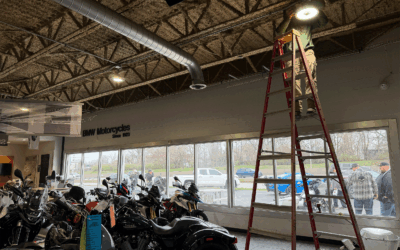
For example, a professional office may prioritize comfortable, consistent lighting, while a warehouse may need reliable illumination across aisles and work areas.
You can see an example of a local office upgrade in our commercial LED lighting project in Jeffersontown.
Why Use a Commercial Electrician for an LED Lighting Upgrade?
Commercial lighting systems can involve more than swapping lamps.
An upgrade may include fixture replacement, rewiring, controls, new circuits, changes to switching or modifications to existing electrical equipment.
A commercial electrician can evaluate the electrical system along with the lighting requirements and determine what work is appropriate for the property.
Laswell’s commercial electrical services include lighting upgrades, electrical maintenance, service improvements, troubleshooting and other work for businesses throughout Kentuckiana.
Commercial LED Lighting in Louisville, KY
The amount a business can save with LED lighting depends on what it is replacing, how long the lights operate and how the new system is designed.
That is why the best way to evaluate an LED upgrade is to start with your own facility rather than a generic savings percentage.
By comparing existing and proposed wattage, operating hours, maintenance requirements and project cost, Louisville businesses can make a more informed decision about whether an LED conversion makes financial sense.
Laswell helps businesses throughout Louisville and Southern Indiana evaluate and install commercial LED lighting systems designed around the needs of their facilities.
If you’re considering an LED lighting upgrade for your business, contact Laswell at 502-231-6326.
Have Questions About Your Business’s Electrical System?
From electrical repairs and preventative maintenance to lighting upgrades, electrical panels, and inspections, Laswell helps businesses throughout Louisville and Southern Indiana keep their electrical systems safe, reliable, and ready for their needs.